


A NATO strap and a Zulu strap can look similar at a glance. Both are nylon, both lean military, and both suit tool watches. But the wearing experience is not the same. Thickness changes how your watch sits. Hardware changes how it feels against skin. Construction changes how quickly you can adjust it, and how tidy it looks once fitted.
This guide compares NATO vs Zulu straps with a practical lens: comfort, thickness, hardware, fit, security, and where each shines for daily wear in Singapore, Hong Kong, and other humid climates.
NATO vs Zulu Straps: What's the Difference?
Here is a side-by-side breakdown of the key specs. The differences become clearer once you see them together.
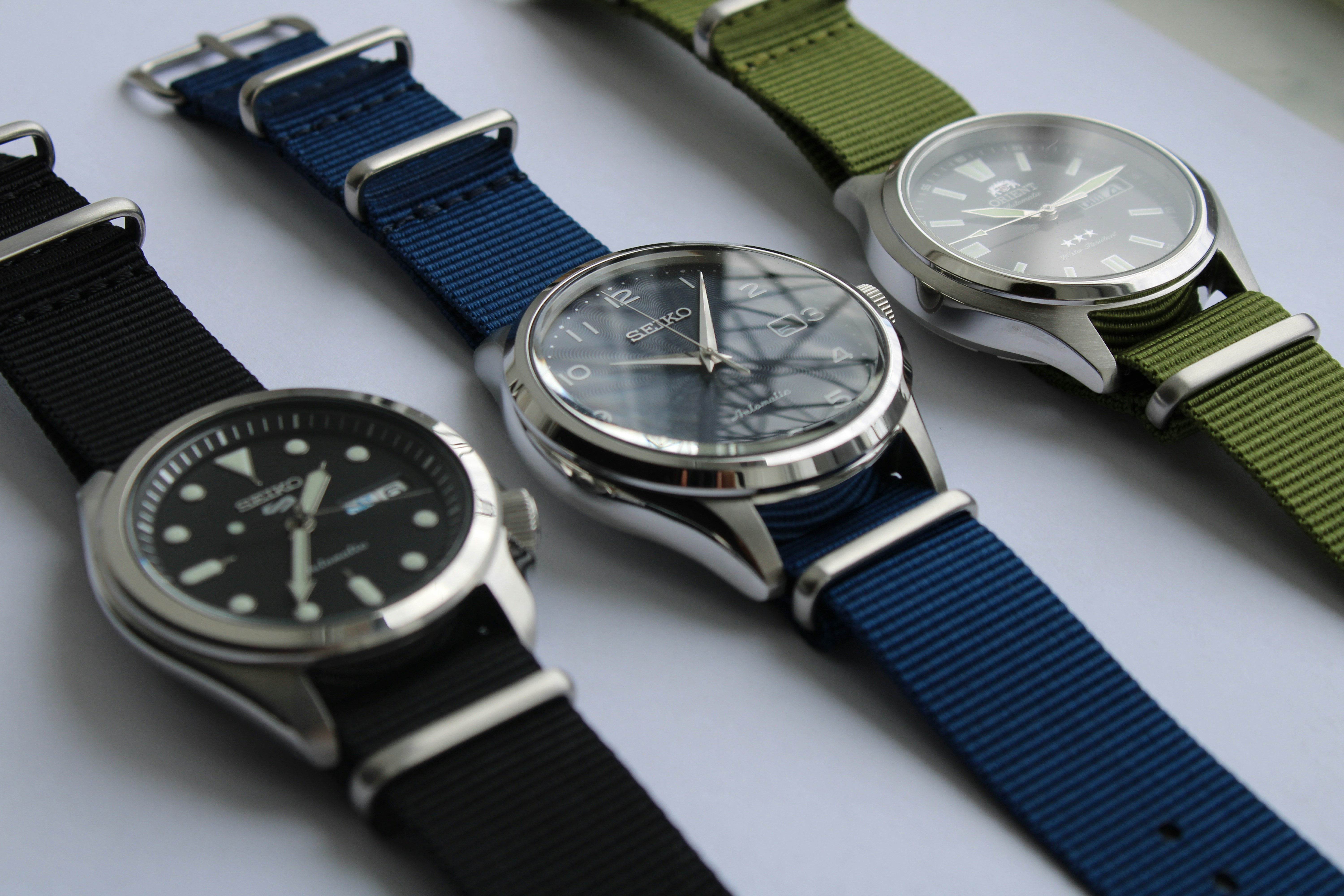
A NATO strap is usually thinner, uses smaller keepers, and often has a secondary under-strap that creates a raised “double-layer” under the watch. It feels lighter and looks cleaner on more watches. For example, a two-piece NATO style leather strap might be an ideal choice for those who prefer leather but want the NATO style.
A Zulu strap is typically thicker, uses larger, rounder hardware (often with 3–5 rings), and can feel more robust but also bulkier. It is favoured when you want heavy-duty nylon, glove-friendly hardware, and a more rugged silhouette.
| Spec | NATO (G1098) | Zulu (3-ring) | Zulu (5-ring) |
|---|---|---|---|
| Nylon thickness | 1.0–1.2mm | 1.4–1.8mm | 1.4–1.8mm |
| Hardware count | 4 squared keepers | Buckle + 2 rounded keepers | Buckle + 4 rounded keepers |
| Safety strap | Yes (short additional length) | No | No |
| Buckle shape | Squared, brushed steel | Rounded, brushed steel or PVD | Rounded, brushed steel or PVD |
| Typical origin | UK / worldwide, MoD-derived | UK (ZULUDIVER), US, custom | US, custom |
| Weight (20mm) | ~12–15g | ~18–24g | ~22–28g |
What “NATO” and “Zulu” actually mean (and why it matters)
“NATO” began as a military procurement style. In modern retail, “NATO strap” usually means a one-piece nylon strap threaded through spring bars, commonly with an extra flap (the secondary under-strap). Many brands also sell single-pass NATOs that remove that extra layer, like those found in the how to install a NATO strap guide.
“Zulu” is less standardised. In common usage, “Zulu strap” refers to a thicker one-piece nylon strap with oversized rings and keepers. Some Zulu straps are single-pass; many use multiple rings for a particular look and perceived strength.
This matters because buyers often compare a double-layer NATO to a thick, multi-ring Zulu and assume the category itself is the difference. In practice, construction choices drive the comfort.
Comfort: which feels better on the wrist?
Comfort is the compound effect of three things:
- Thickness and edge finish
- Hardware size and placement
- How much material sits under the caseback
NATO comfort profile
A typical NATO strap uses thinner nylon and smaller keepers. The strap tends to flex and conform sooner, especially after a few wears and washes. For many wrists, this reads as “soft” and “easy”.
The trade-off is that a traditional NATO has two layers under the watch. That extra layer can trap heat and raise the case (more on that below). In Singapore and Hong Kong humidity, that can be noticeable on larger dive watches.
Zulu comfort profile
A classic Zulu strap is thicker. That thickness can feel reassuring, but it also means:
- slower break-in
- more stiffness at the lugs
- a more pronounced edge against the wrist
Hardware also tends to be larger and heavier. If you sit at a desk, that extra metal can become the first thing you notice as your wrist rests on a laptop edge.
Rule of thumb: if you want a strap that “disappears”, start with a NATO. If you want a strap that feels like equipment, a Zulu tends to deliver that.
Thickness: the real divider (and the easiest way to choose)
Thickness affects:
- whether the strap bunches at the lugs
- whether the tail tucks neatly
Typical thickness ranges (practical expectations)
There is no global standard, but most straps cluster into patterns:
- NATO: often thinner and more pliable, making them suitable for quick-release options as explored in this article.
- Zulu: often thicker and stiffer, like the Zulu Diver Italian rubber strap or the Mayday anchor sailcloth divers watch strap, which can be quite overwhelming for slim or vintage watches.
If your watch already wears tall (many modern divers do), a thick strap can push it into “top-heavy” territory. If your watch is slim or vintage, a thick Zulu can overpower the case and make the watch feel less balanced.
Lug clearance matters
Some watches have tight clearance between spring bar and case. A thick Zulu can be difficult to thread, and sometimes forces you into thinner spring bars or curved bars. A thinner NATO tends to thread more easily.
Quick check: if threading a strap feels like forcing a belt through a letterbox, prioritise a thinner weave.
Hardware: rings, keepers, and what they do to comfort
Hardware is where NATO vs Zulu becomes tactile.
NATO hardware (usually)
- flatter keepers
- smaller loops
- a tidier profile on the wrist
This makes NATO straps easier to pair with watches that are not purely “military”. A field watch, a casual GMT, even some smaller divers can look composed.
Zulu hardware (usually)
- larger rings (often rounded)
- more visual presence
- easier to grab and adjust
That is useful when:
- you adjust straps with wet hands
- you want a strap that reads “rugged” from a distance
- you prefer a chunkier look that matches thick cases
When considering quality, it's essential to know how to spot a high-quality watch strap as this can significantly influence comfort and durability.
Hardware finish and skin feel
Polished keepers can feel smoother at first contact. Brushed hardware hides scratches and suits tool watches. The key is not aesthetics. It is how often hardware touches your desk, your laptop edge, and your wrist bone.
If you type all day: smaller, flatter keepers are usually kinder.
Fit and wearing experience: how each strap sits on the watch
The “lift” effect (double-layer NATO)
A traditional NATO threads through the spring bars, then folds back under the watch on a secondary piece. This creates:
- a raised caseback
- a more secure feel if a spring bar fails
- a warmer, thicker stack under the watch
If you love the security concept but dislike the height, consider a single-pass NATO (one layer under the case). It retains the one-piece threading benefit while reducing bulk.
The “bulk” effect (thick Zulu)
A Zulu strap may be single-pass, but thickness at the lugs can still lift the watch slightly. The bigger issue is often at the sides: thick nylon can flare and create a wider visual footprint.
On a 40mm diver with short lugs, this can look balanced. On a smaller watch, it can look like the strap is wearing the watch.
You might want to explore some options like ZULU Diver Italian Rubber Dive Watch Strap or ZULU Diver Tropical Regis FKM Rubber Watch Strap for a better fit and comfort.
Security: are Zulu straps “safer” than NATO straps?
Both are secure when correctly fitted and used with quality spring bars. The one-piece design is the key advantage. If a spring bar fails, the watch remains attached to the strap via the other bar.
Where differences appear:
- A traditional NATO’s extra layer can reduce the chance of the watch sliding if hardware loosens.
- A thick Zulu can resist stretching slightly better, but can also be harder to thread tightly if the weave is stiff.
Security is less about NATO vs Zulu as labels, and more about:
- spring bar quality
- correct strap width (no undersizing)
- tight, consistent weave
- hardware that does not bend
For those who appreciate a more traditional look or feel in their watch straps, options like WatchGecko Ridge British Military Watch Strap or Hand Stitched Crazy Horse Leather Watch Strap could also be considered for added style and comfort.
Water, sweat, and heat: real-world wear in humid climates
Nylon is popular in SEA for a reason. It dries quickly compared to leather, and it handles sweat without the same long-term staining.
Still, not all nylon wears the same.
NATO in humidity
A thinner NATO tends to:
- dry faster
- feel less dense when soaked
- trap slightly less heat (unless it is double-layer)
Zulu in humidity
A thick Zulu tends to:
- hold more water in the weave
- feel heavier when wet
- take longer to fully dry
If you swim often, shower with your watch, or live in constant humidity, thickness becomes the practical decision point. A slimmer strap is often the calmer choice.

Style and proportion: which strap looks right?
Choose NATO if you want:
- a cleaner, flatter look
- better pairing across watch styles
- less visual weight at the keepers
- easier colour experimentation (black, grey, khaki, navy)
Choose Zulu if you want:
- a bold tool-watch silhouette
- hardware that looks intentionally overbuilt
- a strap that visually matches thick cases, knurled bezels, and tall crystals
Proportion cue: big bezel, big hardware. Minimal dial, minimal hardware.
Hardware count and “ring layouts” (why you see 3-ring, 5-ring, and more)
You will see Zulu straps described by ring count. More rings create more anchor points for the tail and shift where metal sits on the wrist.
- Fewer rings: simpler, often more comfortable
- More rings: more rugged visual language, more metal contact points
If comfort is your priority, do not default to maximum rings. Metal adds weight, and it is the first thing that knocks a desk.
In terms of comfort and usability in humid conditions, it's essential to consider factors such as hardware count and ring layouts while choosing between NATO and Zulu straps.
Sizing: getting the width and length right
Width
Match your lug width exactly. Common sizes include:
- 18mm
- 20mm
- 22mm
A strap that is too narrow will allow the watch to shift. A strap that is too wide will stress spring bars and fray at the edges. Therefore, it's crucial to follow this beginner's guide on how to choose the right watch strap for more insights.
Length
NATO and Zulu straps are often longer than two-piece straps because the tail must fold back. If you have a smaller wrist, excess tail can create a thick fold and a visible “stack”.
If you dislike that fold:
- choose a shorter length
- consider a single-pass strap
- or move to a two-piece NATO-style strap for a cleaner underside
For those considering a more streamlined option, this article on NATO vs Perlon straps provides helpful insights.
When to choose a two-piece NATO (the “cleanest” compromise)
A two-piece NATO (sometimes called a two-piece nylon strap with NATO styling) removes the under-watch layer entirely. It wears like a standard strap but keeps the nylon look.
Choose it when:
- you want NATO aesthetics without added height
- your watch sits tall already
- you want easier on-off without re-threading
This is often the best answer for people who love the idea of nylon straps but dislike the bulk narrative that follows NATOs.

Practical recommendations by watch type
Dive watches
- Daily city wear: thinner NATO or single-pass NATO
- Rugged, glove-friendly vibe: thick Zulu with robust hardware
- If your diver is already tall: avoid double-layer unless you specifically like the lift
Remember, if you're noticing signs your watch strap needs replacing, this comprehensive guide can help. Also, be mindful of common mistakes that could shorten the life of your watch strap, as highlighted in this article.
Field watches
- NATO is usually the natural fit. It matches the watch’s origin story without overpowering the case.
- Zulu works if the case is larger and the dial is busy.
- Alternatively, a vegan leather strap could provide a unique aesthetic while maintaining durability.
Chronographs
- NATO can be surprisingly good, especially in darker colours that reduce strap presence.
- Thick Zulu can fight the watch’s visual complexity unless proportions are carefully matched.
- However, a full grain leather strap might offer a sophisticated look for chronographs.
Buying checklist (comfort, thickness, hardware)
Use this before you choose NATO vs Zulu or consider other options like leather straps.
- Case height: if tall, avoid extra under-watch layers.
- Lug clearance: if tight, avoid very thick straps.
- Desk work: if yes, keep hardware smaller and flatter.
- Humidity exposure: if high, prefer faster-drying, thinner weaves.
- Aesthetic goal: clean utility (NATO) vs rugged equipment (Zulu) or a more refined look (leather).
- Tail management: if you hate folds, consider shorter length or two-piece.
Summary: NATO vs Zulu vs Leather Straps
A NATO strap is usually the more comfortable, versatile choice. It is thinner, lighter, and visually calmer. Its main drawback is bulk under the watch if you choose the traditional double-layer design.
A Zulu strap is usually the more robust-feeling choice. It is thicker, hardware-forward, and built for a bolder tool-watch silhouette. Its main drawbacks are stiffness, slower drying, and more hardware contact on the wrist.
If you're considering leather options like the Austin Air Force Blue full grain leather watch strap, they offer a blend of comfort and style that can be an excellent alternative to both NATO and Zulu straps.
If you want one decisive filter, make it this: choose the strap that best controls thickness, because thickness dictates comfort, heat, and how your watch wears all day.
FAQs (Frequently Asked Questions)
What are the main differences between NATO and Zulu watch straps?
NATO straps are typically thinner, use smaller keepers, and have a secondary under-strap creating a double-layer under the watch, resulting in a lighter feel and cleaner look. Zulu straps are usually thicker, feature larger, rounder hardware with multiple rings (3–5), and offer a more robust, bulkier appearance suited for heavy-duty use.
How do NATO and Zulu straps differ in comfort for daily wear?
NATO straps tend to be softer and more flexible due to thinner nylon and smaller hardware, providing easier break-in and a 'disappearing' feel on the wrist. However, their double-layer design can trap heat under the watch in humid climates like Singapore or Hong Kong. Zulu straps are thicker and stiffer with heavier hardware, which may feel more substantial but can be less comfortable during desk work or in hot weather.
What does the term 'NATO strap' actually mean?
Originally referring to a military procurement style, 'NATO strap' now commonly denotes a one-piece nylon strap threaded through spring bars with an extra flap (secondary under-strap) that creates a double layer beneath the watch. Some brands also offer single-pass NATO straps without this extra layer for a lighter fit.
Why is thickness an important factor when choosing between NATO and Zulu straps?
Thickness affects how high the watch sits on your wrist, whether the strap bunches at the lugs, and if the tail tucks neatly. NATO straps are generally thinner and more pliable, making them suitable for quick-release options and slimmer watches. Zulu straps are thicker and stiffer, which can make watches wear taller or top-heavy, especially modern dive watches.
Which strap type is better suited for humid climates like Singapore or Hong Kong?
In humid climates, thinner NATO straps may be preferable as they flex easily and conform to the wrist quickly after wear. However, their double-layer design can trap heat under larger dive watches. Zulu straps are thicker and may feel bulkier and hotter but offer a rugged aesthetic; personal comfort preferences will guide the choice.
How do hardware differences affect the wearing experience of NATO vs Zulu straps?
NATO straps use smaller keepers that contribute to a lighter feel against the skin. Zulu straps have larger, rounder hardware often comprising multiple rings which add robustness but also increase bulk and weight on the wrist. This hardware difference influences comfort during activities like typing or resting your wrist on surfaces.